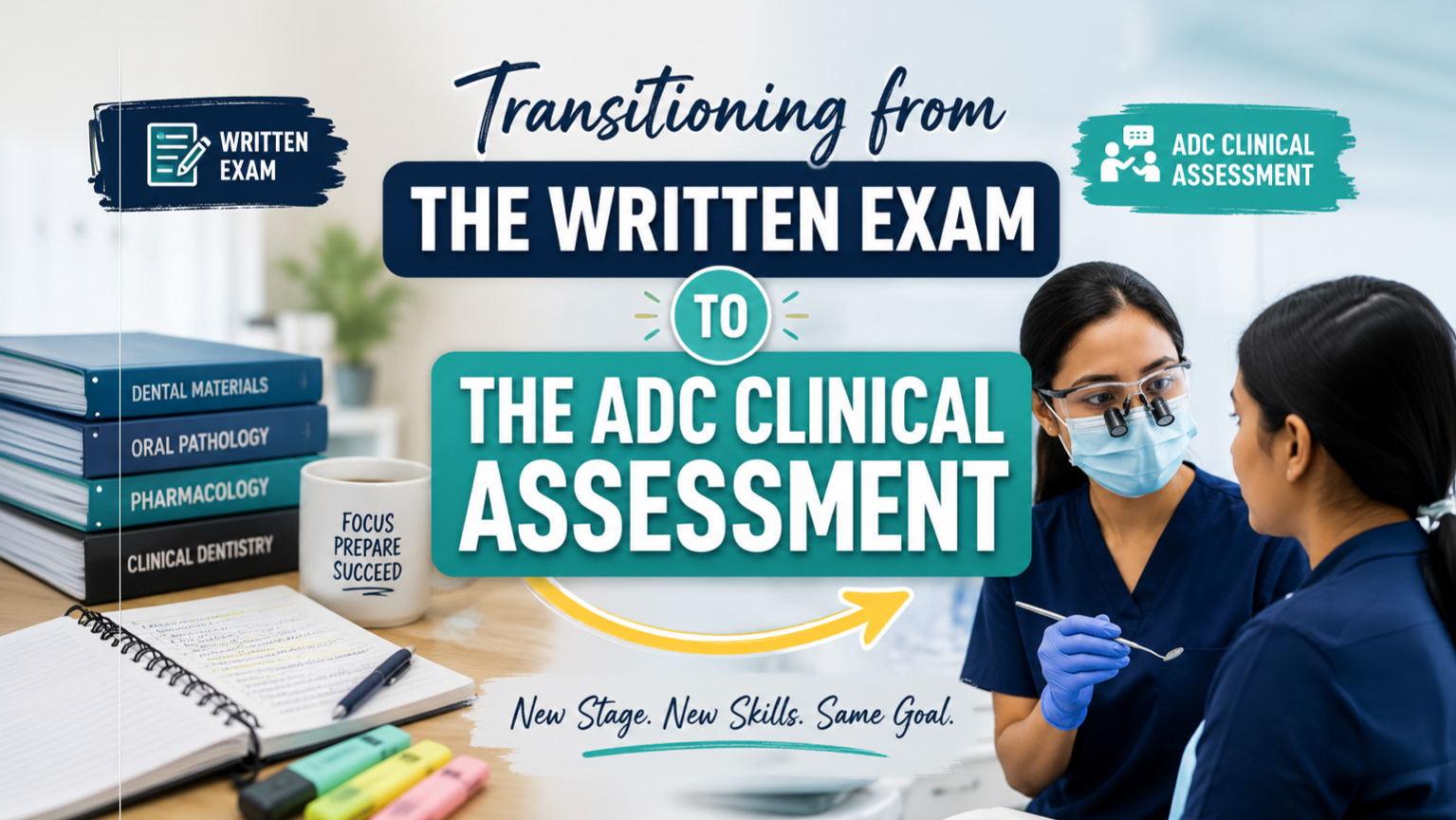
While clearing the written exam is surely a huge milestone in your ADC journey, the next step, ADC Clinical Assessment is when your knowledge is put to test. It involves shifting from theoretical knowledge to demonstrating competency in a hands-on environment. This transition from theory to practice can sometimes feel overwhelming but with the right mindset and preparation, it’s achievable.
Passing the written exam allows you to apply for the practical exam, which must be completed within three years of your written exam success. The written exam focuses on clinical reasoning and scenario-based MCQs and primarily tests your theoretical knowledge through concepts, diagnoses, treatment planning, and clinical reasoning. On the other hand, the practical exam evaluates your ability to apply this knowledge, in a simulated clinical environment, expecting you to meet the standard of a newly qualified Australian dental graduate. Thus, from choosing the correct answer you start performing it.
The practical exam is held over two consecutive days:
- Clinical Skills Day (OSCEs): There will be 10-stations, Objective Structured Clinical Examination (OSCE) where you interact with simulated patients, take histories, explain diagnoses, and develop treatment plans.
- Technical Skills Day: There will be a simulation clinic and you will be performing procedures on dental manikins which includes tooth preparation, restorative dentistry, endodontics, and fixed prosthodontics.
The practical exam requires you to consider aspects like communication, professionalism, and patient management as much as clinical accuracy. The way you management time under pressure, is also critical. It focusses a lot on communication skills and specifically tests your communication with patients, such as breaking bad news or obtaining informed consent. Strict adherence to infection control standards and patient safety is also assessed throughout.
There are some challenges that candidates usually face. They underestimate how different the clinical exam is and feels. Some of the most common hurdles that candidates have to encounter are:
- Performance Anxiety- Performing tasks under observation can be terrifying and may cause anxiety.
- Time Constraints- Expecting to complete procedures within strict time limits, while being assessed on multiple aspects is quite challenging.
- Manual Dexterity- Knowing how to do a procedure is different from executing it precisely.
- Communication Skills- You’ll be assessed on how you interact with patients (or examiners acting as patients), including explaining procedures and demonstrating empathy.
All these can be tackled by altering the way you prepare, strategically. Some of these can be:
- Being part of a clinical workshop can help you to get familiar with Australian dental materials and handpieces. The ADC does not endorse any specific course, but selecting one that involves practicing in a simulation-lab environment, can be beneficial.
- Practicing OSCEs through working in study groups by role-play patient interactions, focusing on communication and time management can equip you better for the exams.
- Familiarizing with Australian guidelines, such as Therapeutic Guidelines and Australian Dental Association (ADA) clinical guidelines, is essential as the exam is tailored to Australian practice standards.
- Prioritizing yourself by managing stress and staying healthy will help maintain focus and fine motor skills during the exam days.
Transitioning from the ADC written exam to the ADC clinical assessment is a tedious but significant step. However, it’s exciting as it is your evolution from an exam candidate to a practicing clinician. Approaching it with discipline, hardwork and a willingness to improve is what gets you there. Studying smarter, focused practice, time management, communication skill development and following proper guidelines is the key to success.