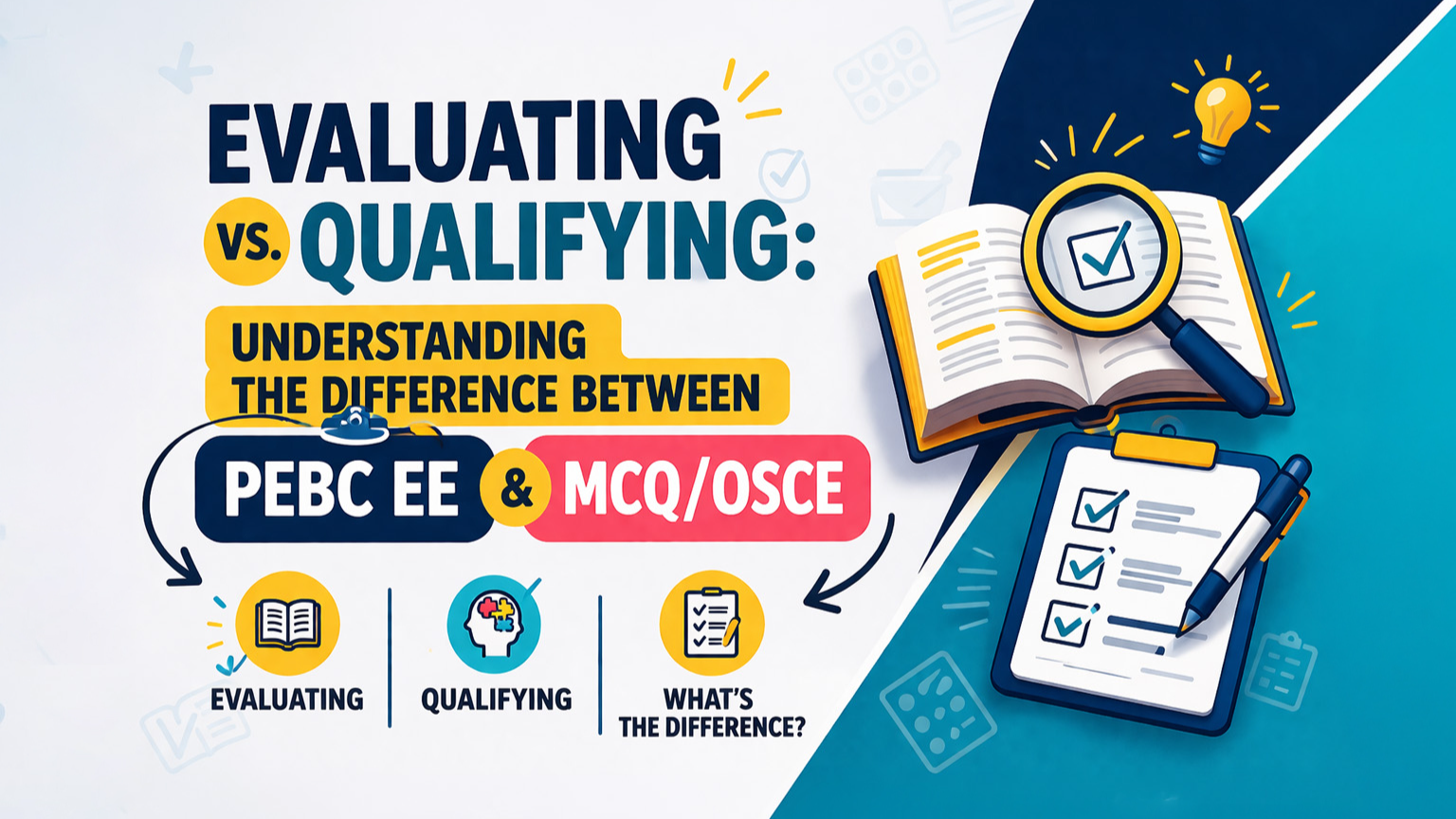
To get started: What is the PEBC?
The Pharmacy Examining Board of Canada (PEBC) is the body that determines whether pharmacy graduates (from Canada or other countries) meet the requirements to practice safely in Canada. Generally, the process involves two main steps:
1. Evaluating Examination (EE)
2. Qualifying Examination (MCQ + OSCE)
This is where the confusion begins.
The Evaluating Exam (EE): Your first Entry Ticket.
Think of the EE as an entrance exam. For internationally trained pharmacists, this is often the first step following the assessment of your credentials to determine whether your pharmacy education meets Canadian standards.
It is a multiple-choice examination, but it is not easy; it aims to determine if you have a strong academic foundation in pharmacology, therapeutics, pharmaceutics, and pharmacy practice.
The key here is:
The EE is knowledge based, not application based.
The question is:
•Are you familiar with the fundamentals of pharmacy?
•Do you have a strong academic foundation?
It is not testing communication skills or patient interaction yet. If you succeed in this stage, you advance. If not, you may have to focus on your fundamentals.
The Qualifying Exam: The Real Thing
You can take the two-part Qualifying Exam after passing the EE:
• MCQ (Part I)
• OSCE (Part II)
This is the point at which the transition from "what you know" to "how you use what you know" happens.
MCQ: Clinical Knowledge (Applied Knowledge, Part I)
It is still multiple-choice, but it is significantly different from the EE.
The qualifying exam multiple-choice questions focus on clinical decision-making and will present you with patient cases and ask you to:
• Choose the best course of treatment
• Interpret laboratory results
• Apply guidelines in real-world scenarios
• Identify drug-related problems.
As a result, you will be required to reason like a pharmacist, not just memorize facts. The application of knowledge is more important than the recall of facts.
OSCE (Part II): Clinical Simulation
The final part of the exam, the OSCE, is the most challenging (and, in truth, the most interesting) for most applicants as it is a hands-on, station-based exam in which you interact with simulated patients or scenarios.
You may be asked to:
· give a patient advice about a new drug
· identify and correct a prescription error
· communicate with a health care professional
· manage a difficult or sensitive patient situation.
It assesses your ability to communicate, your clinical decision-making skills, your expertise, and your confidence under pressure.
In simple terms: The OSCE tests your ability to function in the real world as a pharmacist.
What Is the Real Difference, Then?
You can think of it this way:
• EE (evaluating exam)→Are you knowledgeable?
•Qualifying multiple-choice question→ Can you apply the knowledge?
•OSCE→ Are you able to perform in real life?
Each step progresses from the previous step.
The Importance of This Distinction: This progression is important to your preparation. Candidates often prepare for all exams in the same way, focusing only on theory, which may be useful for the EE but will not be enough for the qualifying phases.
For OSCE and MCQ, you will need to:
•Apply case-based learning
•Refine communication skills
•Think clinically, not academically.
The PEBC exam pathway is not about passing exams; it is about creating a capable, patient-centered pharmacist in Canada. So, think of the EE and qualifying exams as a process rather than as two obstacles: You demonstrate your knowledge; you demonstrate your competence; and you demonstrate your readiness to practice, and everything falls into place and makes more sense—and is therefore much more manageable—when you begin preparing with this mindset.